

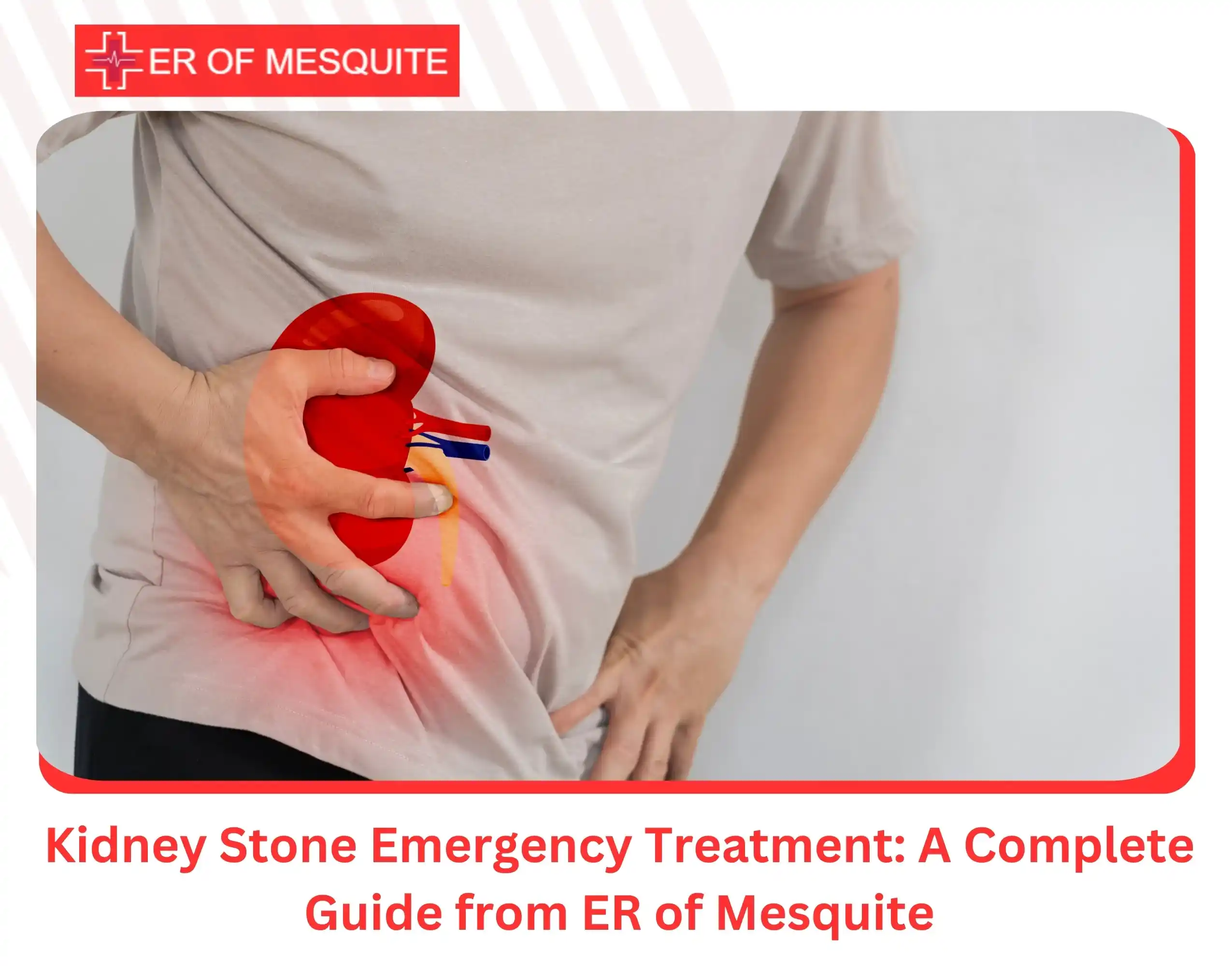
Anyone who’s had a kidney stone will tell you the same thing: it’s one of the worst pains imaginable. Many people — including women who’ve given birth — describe kidney stone pain as worse than childbirth. The pain comes in sudden, crushing waves, often starting in the back and traveling down to the groin, leaving you unable to sit still, eat, or even think clearly.
This guide from ER of Mesquite walks you through what kidney stones are, why they form, how to recognize the signs, and when it’s time to stop suffering at home and get emergency relief. Our 24/7 freestanding emergency room in Mesquite, TX is staffed by board-certified physicians who can deliver IV pain relief within minutes of your arrival — no waiting, no triage backups.
1. What Are Kidney Stones?
How Kidney Stones Form
Kidney stones are hard, crystalline mineral deposits that form inside your kidneys. They develop when your urine contains more crystal-forming substances — like calcium, oxalate, and uric acid — than the fluid in your urine can dilute. At the same time, your urine may lack substances that prevent crystals from sticking together, creating the perfect environment for stones.
Stones can range from the size of a grain of sand to as large as a golf ball. Smaller stones often pass on their own, while larger ones can get stuck in the urinary tract — causing severe pain and potential damage.
The 4 Types of Kidney Stones
Not all kidney stones are the same. Knowing your type matters for both treatment and prevention:
| Stone Type | How Common | Main Cause | Prevention Focus |
| Calcium Oxalate | 80% of all stones | High oxalate diet, low calcium intake | Hydration, balanced calcium |
| Uric Acid | 5–10% | High protein diet, gout, dehydration | Reduce red meat, alkalinize urine |
| Struvite | 5–10% | Recurrent urinary tract infections | Treat underlying UTIs promptly |
| Cystine | Less than 1% | Genetic disorder (cystinuria) | High water intake, specialist care |
Who’s at Highest Risk?
Roughly 1 in 10 Americans will have a kidney stone at some point in their lives — and once you’ve had one, you have a 50% chance of having another within 5 years. People most at risk include:
- Men between ages 30 and 50 (though women’s rates are rising)
- People living in hot climates — including Texas — due to dehydration
- Anyone with a family history of kidney stones
- People with obesity, diabetes, or high blood pressure
- Those who’ve had bariatric surgery or chronic GI conditions
2. Common Causes & Risk Factors
Dehydration — The #1 Driver
Dehydration concentrates your urine, which lets crystals form more easily. In Mesquite and across Texas, summer temperatures regularly push past 100°F — and people who work outdoors, exercise outside, or simply don’t drink enough water during the day are at dramatically higher risk of forming stones during warmer months. Texas, Arizona, and other Sun Belt states are part of what doctors call the “kidney stone belt” for exactly this reason.
Dietary Triggers
- High sodium intake — pushes more calcium into your urine.
- Animal protein (red meat, organ meats, shellfish) — increases uric acid and reduces stone-preventing citrate.
- High-oxalate foods (spinach, beets, nuts, chocolate, tea) — can contribute to calcium oxalate stones in susceptible people.
- Sugar-sweetened beverages — including sodas with phosphoric acid.
- Vitamin C megadoses (over 1,000 mg/day) — convert to oxalate in the body.
Medical Conditions That Increase Risk
- Hyperparathyroidism (overactive parathyroid glands)
- Gout (high uric acid)
- Inflammatory bowel disease (Crohn’s, ulcerative colitis)
- Chronic urinary tract infections
- Renal tubular acidosis
- Cystinuria (genetic)
Family History & Genetics
If a parent or sibling has had kidney stones, your risk roughly doubles. Genetics influence both stone formation tendency and the type of stones you’re likely to develop.
Medications That Raise Stone Risk
- Diuretics (water pills)
- Calcium-based antacids in high doses
- Topiramate (used for seizures and migraines)
- Some HIV medications
- Long-term corticosteroid use
3. Recognizing Kidney Stone Symptoms
Kidney stones don’t always cause symptoms — small ones can pass unnoticed. But once a stone moves into a narrow part of the urinary tract, the pain and other warning signs are unmistakable.
The Hallmark Pain — What It Really Feels Like
Kidney stone pain (called renal colic) typically:
- Comes on suddenly, often without warning
- Arrives in waves that intensify and ease every 20–60 minutes
- Feels sharp, cramping, and impossible to ignore
- Can’t be relieved by changing position — unlike muscle pain
- Often hits in the middle of the night or early morning
Where the Pain Travels — Flank to Groin
Classic kidney stone pain follows a predictable path as the stone moves through the urinary tract:
- Stage 1: Sharp pain in the back or side, just below the ribs (the flank)
- Stage 2: Pain radiates downward into the lower abdomen
- Stage 3: Pain travels to the groin, genitals, or inner thigh
If you can map your pain along this path, kidney stones are a very likely culprit.
Urinary Symptoms
- Blood in the urine (hematuria) — pink, red, or brown coloration; sometimes only visible under microscope
- Burning sensation during urination
- Frequent urge to urinate, often producing only small amounts
- Cloudy or foul-smelling urine — may signal infection
- Difficulty urinating — stone blocking the flow
Systemic Symptoms
- Nausea and vomiting — very common, often making oral pain meds impossible
- Fever and chills — a major red flag that signals infection
- Sweating, restlessness, and an inability to find a comfortable position
Symptoms in Women vs. Men vs. Children
Symptoms are largely the same across groups, but kidney stone pain in women is sometimes mistaken for menstrual cramps, ovarian cysts, or appendicitis. In men, the pain often radiates into the testicles. In children, kidney stones may show up as vague abdominal pain, vomiting, or unexplained fussiness — and require imaging to diagnose.
| ⚡ Suffering through kidney stone pain right now? Don’t push through it — IV pain relief is minutes away. Walk in 24/7 to ER of Mesquite at 1745 N Belt Line Rd, Mesquite, TX or call (214) 377-8495. No appointment needed. No waiting room delays. |
4. When Kidney Stones Become a Medical Emergency
Warning Signs That Mean “Go to the ER Now”
Most kidney stones are painful but not life-threatening. However, certain symptoms turn a kidney stone into a true medical emergency:
- Fever above 101°F with chills — suggests an infection trapped behind the stone (urosepsis can be fatal)
- Persistent vomiting that prevents you from keeping fluids down
- Pain so severe you can’t sit still, function, or speak in full sentences
- Inability to urinate at all
- Visible blood with clots in the urine
- Confusion or extreme weakness
- Only one functioning kidney — any obstruction is dangerous
- Pregnancy with suspected stone symptoms
Kidney Stones vs. Other Causes of Flank Pain
Several other conditions can mimic kidney stone pain — and some are equally serious. They include:
- Kidney infection (pyelonephritis) — fever, back pain, and burning urination
- Appendicitis — right-sided pain, often shifting from belly button to lower right
- Ovarian cyst rupture — sudden lower abdominal pain in women
- Aortic aneurysm — back pain in older adults, especially men over 60
- Diverticulitis — left-sided lower abdominal pain with fever
Imaging is the only reliable way to tell these apart — which is why ER evaluation matters.
Why Untreated Stones Can Damage Your Kidneys
A stone blocking urine flow puts pressure on the kidney. After 1–2 weeks of obstruction, the kidney can begin to lose function. After 6 weeks, that damage may be permanent. If infection develops behind a blocked stone, it can spread to the bloodstream and cause life-threatening sepsis within hours.
Decision Matrix — ER, Urgent Care, or Home?
| Go to the ER Now | Same-Day Care OK | Manage at Home (with caution) |
| Severe pain not controlled by OTC meds | Moderate flank pain that comes and goes | Mild discomfort, stone already diagnosed |
| Fever above 101°F or chills | Visible blood in urine without fever | Plenty of urine output, no nausea |
| Persistent vomiting, can’t keep fluids down | Burning urination without fever | Drinking water freely, pain manageable |
| Inability to urinate at all | Pain manageable with OTC medication | Following urologist’s plan for known stone |
| Only one functioning kidney | First-time symptoms during business hours | No fever, no vomiting, no shaking chills |
5. What NOT to Do During a Kidney Stone Attack
Don’t Try to “Tough It Out” With Severe Pain
Kidney stone pain is a signal that something is genuinely wrong. Severe pain often means the stone is large, lodged, or accompanied by infection. Suffering at home wastes time and risks kidney damage.
Don’t Take More OTC Painkillers Than Recommended
It’s tempting to keep doubling up on ibuprofen or acetaminophen when nothing’s working — but exceeding the daily limit can cause kidney damage, GI bleeding, or liver injury, especially when you’re already dehydrated and stressed. If OTC meds aren’t helping, that’s the signal to come in for IV-strength relief.
Don’t Drink Large Quantities of Beer or Cranberry Juice
Two of the most common kidney stone myths:
- Beer doesn’t “flush out” stones. It’s a diuretic that worsens dehydration and can actually contribute to uric acid stone formation.
- Cranberry juice doesn’t dissolve stones. It can help prevent some UTIs but contains oxalate that may worsen the most common type of stone.
The real answer is plain water — but if pain is severe or you’re vomiting, hydration alone isn’t enough.
Don’t Ignore Fever or Vomiting
Fever with kidney stone pain is a medical emergency until proven otherwise. It can signal an infection trapped behind the stone, which can progress to sepsis within hours. Persistent vomiting also requires IV fluids and IV anti-nausea medication — neither of which you can get at home.
6. Kidney Stone Treatment at ER of Mesquite
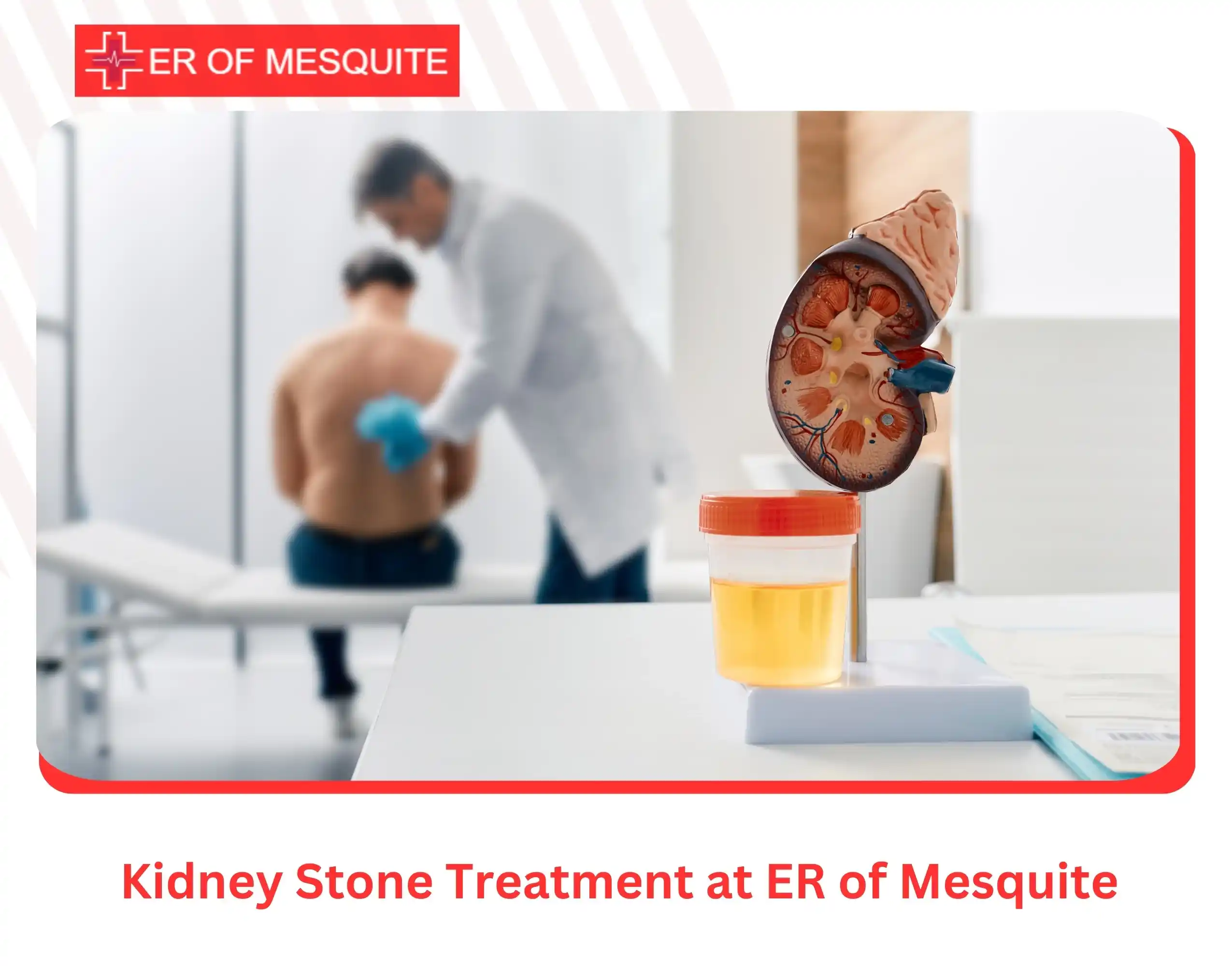
From the moment you walk in, ER of Mesquite treats severe kidney stone pain as a top-priority emergency. There’s no waiting room delay — you’re seen within minutes by a board-certified emergency physician.
Our 24/7 Kidney Stone Emergency Protocol
Pain relief comes first. While diagnostics begin in parallel, our team starts IV pain management within minutes — because suffering through a workup is unnecessary and unkind. Most patients feel significant relief before imaging is even complete.
Diagnostic Tools — Hospital-Grade, On-Site
- CT scan (non-contrast) — the gold standard for diagnosing kidney stones; pinpoints stone size, location, and obstruction. Learn about our CT scan services.
- Ultrasound — used especially for pregnant patients and children to avoid radiation. See our ultrasound services.
- Urinalysis — checks for blood, infection, and crystals.
- Blood work — evaluates kidney function, electrolyte balance, and signs of infection. Learn about our certified laboratory services.
Fast Pain Relief & Treatment Pathways
Once we’ve confirmed kidney stones, treatment focuses on three goals: pain control, hydration, and helping the stone pass:
- IV pain medications — ketorolac (Toradol), morphine, or other opioids when needed; far stronger than oral options.
- IV fluids — restore hydration and help flush the stone. Learn about our IV fluids and antibiotics services.
- IV anti-nausea medications — stop vomiting, allow you to keep down oral medications.
- Alpha-blockers (tamsulosin) — relax the ureter to help the stone pass faster.
- Antibiotics — if infection is present or suspected.
- Pain prescription for at-home use after discharge while the stone passes.
Stone Passage vs. Surgical Referral
About 80% of kidney stones smaller than 5 mm pass on their own with hydration and pain management. Stones larger than 10 mm rarely pass without procedural help. We coordinate urology referrals when:
- The stone is too large to pass on its own
- Pain is uncontrollable despite medication
- There’s complete blockage or signs of infection
- Kidney function is starting to decline
- You only have one functioning kidney
Common procedures include shock wave lithotripsy (ESWL), ureteroscopy, and percutaneous nephrolithotomy — performed by urologists at partner hospitals.
What to Expect From Walk-In to Discharge
As a freestanding emergency room, we deliver hospital-grade emergency care without the long hospital wait. Expect rapid evaluation, immediate IV pain relief, complete imaging, and a clear discharge plan with prescriptions, a strainer for catching the stone (so it can be analyzed), and urology referrals when needed.
7. Preventing Future Kidney Stones
Once you’ve had one stone, you’re at high risk for another. The good news: most recurrences are preventable with smart changes.
Hydration — How Much Water You Actually Need
The single most effective prevention strategy is drinking enough water to produce at least 2.5 liters (84 ounces) of urine per day. For most adults, that means 3 liters (about 100 ounces) of fluid daily — more in Texas heat or with heavy physical activity. Plain water is best; lemon water adds citrate, a natural stone inhibitor.
Dietary Changes by Stone Type
For calcium oxalate stones (most common):
- Reduce sodium to under 2,300 mg/day
- Eat normal amounts of calcium with meals (don’t restrict — it actually binds oxalate in the gut)
- Limit oxalate-heavy foods only if testing shows high urinary oxalate
- Increase citrate intake (lemons, limes)
For uric acid stones:
- Reduce red meat, organ meats, and shellfish
- Limit alcohol, especially beer
- Increase fruits and vegetables to alkalinize urine
For struvite stones:
- Treat any urinary tract infection promptly and completely
- Follow up with imaging to confirm full clearance
When to See a Urologist or Nephrologist
Consider specialist follow-up if you’ve had:
- Two or more stones in a lifetime
- Stones in childhood or adolescence
- A family history of recurrent stones
- Kidney function decline
- Unusual stone composition (cystine, struvite)
Tracking Recurrence
Save any stones you pass — analyzing the chemical composition helps determine prevention strategy. A 24-hour urine collection (ordered by your urologist) reveals exactly what’s driving stone formation in your body.
8. Don’t Suffer Through Kidney Stone Pain — Visit ER of Mesquite

Kidney stone pain is one of the few experiences that can stop you cold. You don’t have to ride it out at home, and you don’t have to wait hours in a hospital ER. At ER of Mesquite, board-certified emergency physicians are on duty 24 hours a day with on-site CT scanning, IV pain medications, and the diagnostic tools needed to confirm the cause and start kidney stone treatment within minutes. Walk in any time, day or night.
| 📍 ER of Mesquite — 24/7 Emergency Care Address: 1745 N Belt Line Rd, Mesquite, TX 75149 Phone: (214) 377-8495 Hours: Open 24 hours a day, 7 days a week, 365 days a year Walk-Ins Welcome: No appointment needed Imaging On-Site: CT scan, ultrasound, digital X-ray Insurance: All major commercial insurance accepted |
Frequently Asked Questions About Kidney Stones
How long does it take to pass a kidney stone?
It depends on the size and location. Small stones (under 4 mm) typically pass within 1–2 weeks; medium stones (4–6 mm) may take up to 45 days. Stones larger than 6 mm often need procedural help. If you haven’t passed a stone within 4–6 weeks, follow up with a urologist.
Can I pass a kidney stone at home?
Many small stones do pass at home with hydration and OTC pain medication. But you should seek emergency care if pain becomes severe, you develop fever or vomiting, you can’t urinate, or symptoms last more than a few days. Never “tough it out” with a stone you haven’t been evaluated for — undiagnosed obstruction can damage your kidney.
What does kidney stone pain feel like compared to other pain?
Most patients describe it as worse than childbirth or a broken bone. The pain is sharp, cramping, and comes in waves. It’s distinctive in that you can’t get comfortable — unlike muscle pain that eases with rest, kidney stone pain forces people to pace, rock, or curl up.
Are kidney stones genetic?
Genetics play a significant role. Having a parent or sibling with kidney stones roughly doubles your risk. Some stone types — particularly cystine stones — are caused by inherited conditions. But diet, hydration, and lifestyle still strongly influence whether you actually form stones.
Do kidney stones come back?
Yes, frequently. About 50% of people who have one stone will have another within 5 years, and 80% within 10 years — without preventive measures. The good news is that with proper hydration, dietary changes, and (when needed) preventive medications, recurrence rates drop substantially.
Will my insurance cover an ER visit for kidney stones?
Most commercial insurance plans cover emergency kidney stone treatment, including imaging, IV pain control, and hydration. ER of Mesquite accepts all major commercial insurance plans. Visit our insurance coverage page or learn about our no surprise billing policy for full details. We also offer flexible payment plans for uninsured patients.
How fast can I be seen at ER of Mesquite for a kidney stone?
Most patients are evaluated within minutes of arrival, and IV pain relief usually starts before imaging is complete. As a freestanding ER, we have no triage backups and no overcrowded waiting rooms — the fastest path from severe pain to relief in Mesquite.