

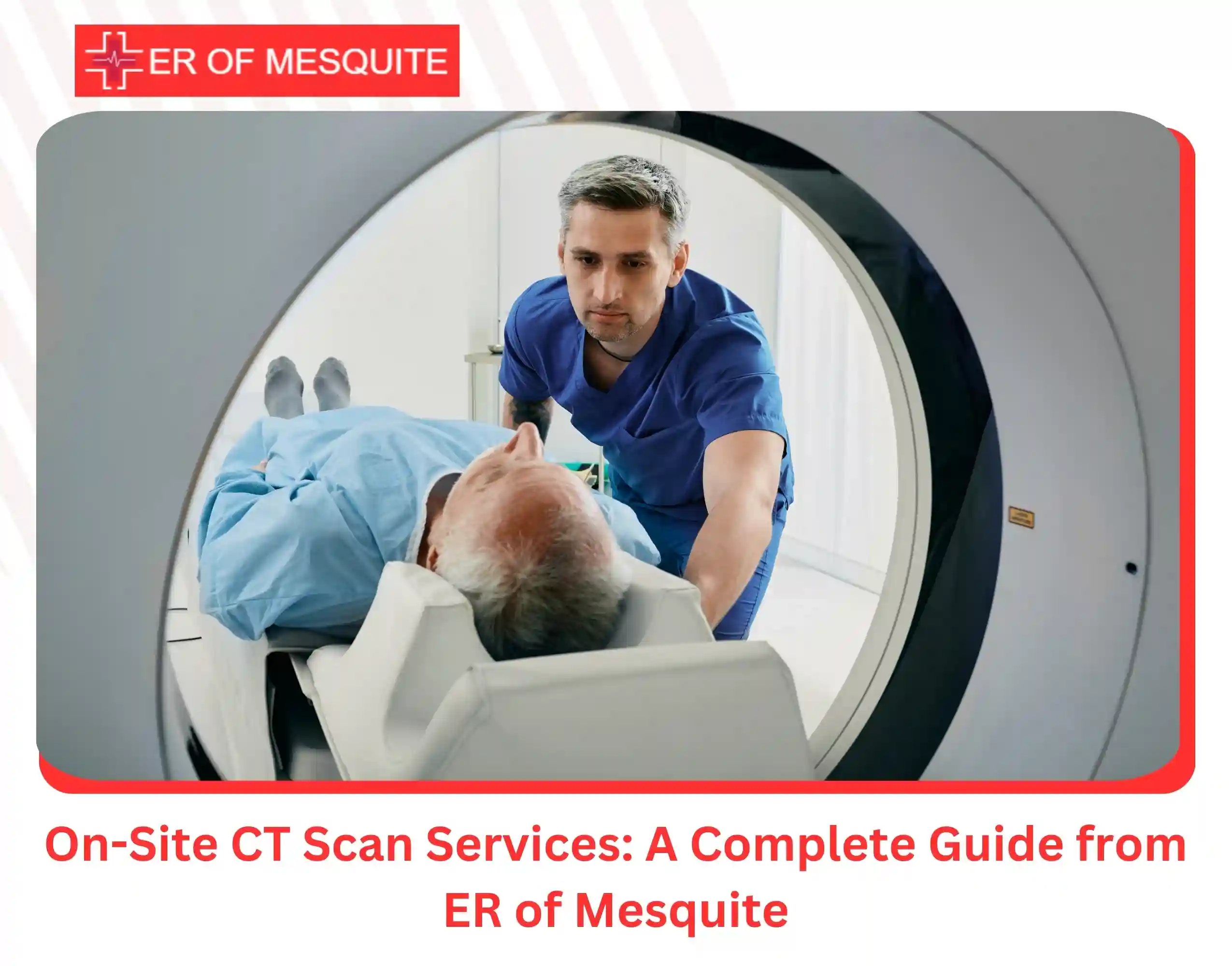
In emergency medicine, a CT scan often makes the difference between a guess and a diagnosis. When you arrive with chest pain, severe abdominal pain, a head injury, or symptoms that could be a stroke, the answers are usually invisible from the outside — locked behind your skin, bones, and tissue. A CT scan reveals those answers in minutes, helping our physicians act fast and accurately when time matters most.
This guide from ER of Mesquite walks you through what a CT scan is, when you need one, what to expect during the procedure, and how to know it’s safe. Unlike most urgent cares and stand-alone imaging centers, we have a hospital-grade CT scanner on-site, available 24 hours a day, 7 days a week — so walk-in patients can be imaged within minutes and get results read by a board-certified emergency physician immediately.
1. What Is a CT Scan?
How CT Scans Work (Brief, Non-Technical)
A CT scan — short for computed tomography — uses a series of X-ray beams taken from many angles around your body. A computer then assembles those images into detailed cross-sectional pictures (“slices”) that show bones, organs, blood vessels, and soft tissue in remarkable detail. Think of it like taking a loaf of bread and looking at each individual slice instead of just the outside.
Where a single X-ray gives one flat image, a CT scan gives doctors a three-dimensional view — making it dramatically better at finding internal bleeding, blood clots, organ damage, kidney stones, tumors, and many other conditions an X-ray would miss.
CT Scan vs. X-Ray vs. MRI vs. Ultrasound — Key Differences
Each imaging method has strengths. Doctors choose based on what they’re looking for and how fast they need answers.
| Feature | CT Scan | MRI | X-Ray |
| Technology | X-rays + computer imaging | Magnetic fields and radio waves | Single-direction X-rays |
| Best For | Bones, organs, bleeding, clots | Soft tissue, brain, spine, joints | Bones, lungs, dental, foreign objects |
| Scan Time | 5–15 minutes | 30–60 minutes | Under 5 minutes |
| Radiation | Moderate | None | Low |
| In Emergencies | Top choice — fast & detailed | Slower; limited availability | Quick first-line imaging |
In the emergency room, CT scans are the workhorse — fast enough for life-threatening situations, detailed enough to find what’s wrong, and able to image nearly any part of the body. See how our digital X-ray and ultrasound services complement our CT capabilities for complete on-site imaging.
2. When Do You Need a CT Scan?
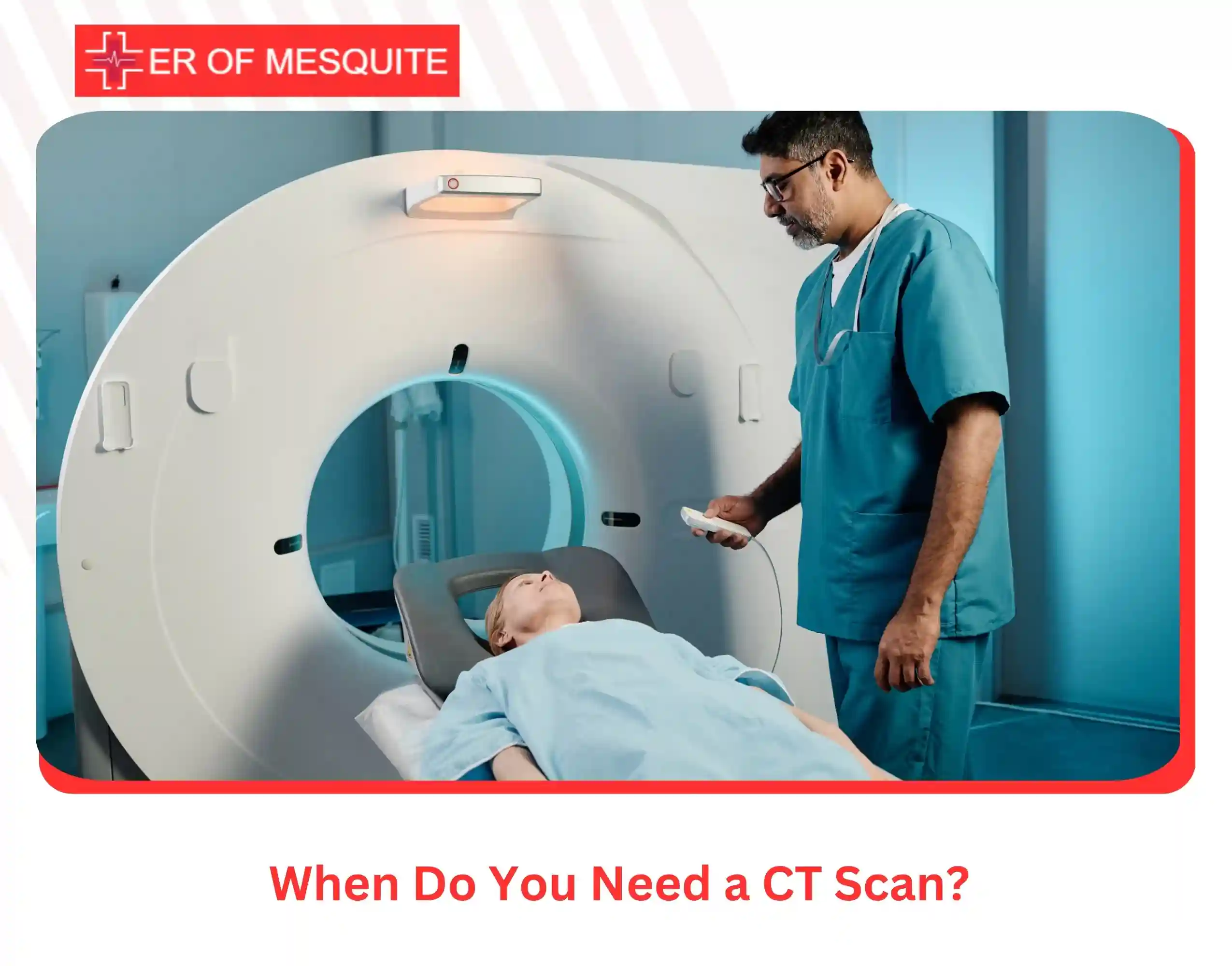
CT scans are ordered when doctors need fast, detailed answers about internal injuries, infections, or disease. Here are the most common emergency situations where a CT scan is essential.
Emergency Situations
- Stroke evaluation — a brain CT distinguishes ischemic stroke (clot) from hemorrhagic stroke (bleeding), guiding every treatment decision. Learn more in our stroke emergency care guide.
- Head trauma — after a fall, sports injury, or car accident, a CT scan rules out skull fracture, brain bleeding, or concussion-related complications.
- Chest pain — CT angiography can identify pulmonary embolism, aortic dissection, and other life-threatening causes. Read our chest pain emergency guide.
- Severe abdominal pain — CT is the gold standard for diagnosing appendicitis, kidney stones, bowel obstruction, and many other surgical emergencies. See our abdominal pain emergency guide.
Suspected Internal Injuries from Trauma
After a car accident, fall, or significant impact, a CT scan can quickly identify internal bleeding, organ damage, broken ribs, vertebral fractures, and pelvic fractures — injuries that wouldn’t show up on a physical exam but can become life-threatening if missed.
Identifying Kidney Stones & Urinary Tract Issues
A non-contrast CT scan is the most reliable test for diagnosing kidney stones. It pinpoints the stone’s size, location, and whether it’s causing blockage — information that drives every treatment decision. Learn more in our kidney stone treatment guide.
Cancer Detection & Staging
CT scans can detect tumors in the lungs, liver, pancreas, kidneys, and many other organs. In emergency settings, they sometimes reveal cancers that have caused acute symptoms like bleeding, obstruction, or sudden pain.
Pulmonary Conditions
CT pulmonary angiography (CTPA) is the test of choice for diagnosing pulmonary embolism — a life-threatening blood clot in the lungs. CT scans also identify pneumonia, fluid around the lungs, lung nodules, and chronic lung disease.
Bone & Joint Imaging When X-Ray Isn’t Enough
X-rays are the first imaging step for suspected fractures, but complex fractures, joint injuries, or fractures in difficult-to-image areas (spine, pelvis, facial bones) often need CT for full detail. See our broken bone and fracture treatment guide.
| ⚡ Think you need a CT scan? You don’t need a referral. Walk in 24/7 to ER of Mesquite at 1745 N Belt Line Rd, Mesquite, TX or call (214) 377-8495. On-site CT scanning with results read immediately by a board-certified emergency physician. |
3. Types of CT Scans Offered at ER of Mesquite
Different parts of the body require different CT scan techniques. Our on-site scanner can perform all of the following:
| Scan Type | What It Examines | Common Reasons |
| Head / Brain | Brain, skull, sinuses | Stroke, head trauma, severe headache |
| Chest | Lungs, heart, major blood vessels | Pulmonary embolism, pneumonia, chest pain |
| Abdomen & Pelvis | Stomach, intestines, kidneys, reproductive organs | Appendicitis, kidney stones, abdominal pain |
| CT Angiography (CTA) | Blood vessels throughout the body | Aortic aneurysm, blood clots, vascular disease |
| Musculoskeletal | Complex fractures, joints, bone tumors | Detailed bone imaging when X-ray isn’t enough |
CT Scan of the Head/Brain
The fastest scan we perform — usually under 5 minutes. Used for stroke evaluation, head injuries, severe headaches, suspected meningitis, and to rule out brain bleeding. Often performed without contrast in acute emergencies.
CT Scan of the Chest
Visualizes lungs, heart, blood vessels, ribs, and the thoracic spine. Critical for diagnosing pulmonary embolism, pneumonia, aortic dissection, lung masses, and traumatic chest injuries. May be performed with contrast for vascular detail.
CT Scan of the Abdomen & Pelvis
One of the most ordered emergency CT scans. Identifies appendicitis, kidney stones, bowel obstruction, perforated organs, ovarian issues, internal bleeding, and many other causes of severe abdominal pain. Often performed with both IV and oral contrast for maximum detail.
CT Angiography (CTA)
A specialized CT scan that focuses on blood vessels, using IV contrast to make arteries and veins clearly visible. Used to diagnose aortic aneurysm, blood clots, vascular blockages, and stroke-related vessel issues.
CT Scan With vs. Without Contrast
- Without contrast: Used for kidney stones, acute head injuries, and bone imaging. Faster, no IV needed.
- With contrast: Used for vascular imaging, infection workup, tumor evaluation, and most abdominal scans. IV contrast highlights blood vessels and organ tissue.
The physician decides which approach best answers the question at hand.
4. What to Expect During a CT Scan

Before the Scan — Preparation
Preparation depends on the type of scan:
- Most ER CT scans require little to no preparation — you’ll be scanned shortly after arrival.
- If contrast is used, you may be asked about kidney function, allergies, and pregnancy possibility.
- For abdominal scans with oral contrast, you may need to drink a contrast solution 30–60 minutes before the scan.
- You’ll be asked to remove metal items (jewelry, hairpins, certain clothing) that could affect image quality.
During the Scan — Step-by-Step
- You’ll lie on a motorized table that slides through the CT scanner — an open, donut-shaped ring (not a closed tube like an MRI).
- If contrast is needed, an IV will be placed. You may feel a brief warm sensation when the contrast is injected.
- The table slides slowly through the scanner while the X-ray ring rotates around you.
- You may be asked to hold your breath for a few seconds during chest or abdominal scans.
- Stay as still as possible — movement blurs the images.
- The technologist will monitor you from a nearby room and can speak with you through an intercom the whole time.
After the Scan — What Happens Next
The technologist immediately reviews the images for quality. A board-certified ER physician reads the scan within minutes — not hours or days like an outpatient imaging center. You can resume normal activities right away. If you received IV contrast, drink extra water for the rest of the day to help your kidneys flush it out.
How Long Does a CT Scan Take?
- The scan itself: 5–15 minutes for most studies, sometimes under 30 seconds for the actual image capture.
- From walk-in to results at ER of Mesquite: usually under an hour, often much less.
Compare that to outpatient imaging centers, where scheduling alone can take days, results take 24–72 hours, and you have to wait for your doctor to interpret them.
5. CT Scan Safety, Radiation & Common Concerns

How Much Radiation Is in a CT Scan?
CT scans do use ionizing radiation. The amount depends on the body area scanned: a head CT delivers roughly the equivalent of 8 months of natural background radiation; an abdominal CT, about 3 years’ worth. While that sounds significant, for emergency situations, the diagnostic value vastly outweighs the small theoretical risk. Missing a stroke, appendicitis, or pulmonary embolism is far more dangerous than the radiation from a CT scan.
Is a CT Scan Safe During Pregnancy?
CT scans during pregnancy are avoided when possible, especially in the first trimester. When alternatives like ultrasound or MRI can answer the question, those are preferred. However, in life-threatening emergencies (suspected pulmonary embolism, severe head trauma, ruptured appendix), the benefit of a quick diagnosis usually outweighs the risk — and we use lower-dose protocols and abdominal shielding to minimize fetal exposure. Always tell us if you’re pregnant or might be.
Contrast Dye — Risks & Allergic Reactions
Modern IV contrast (iodine-based) is generally very safe. Mild reactions like warmth, metallic taste, or a brief flush are normal. More significant allergic reactions are rare — and we screen carefully before giving contrast. People with kidney disease, severe allergies to contrast, or certain medications (like metformin) may need adjusted plans or alternative imaging. Tell us about any prior reactions to contrast dye.
CT Scans in Children — When They’re Necessary
Children are more sensitive to radiation than adults, so doctors weigh the benefits carefully before ordering a CT scan in pediatric patients. When a CT is necessary — such as for head trauma, severe abdominal pain, or suspected appendicitis — we use pediatric-specific low-dose protocols that significantly reduce radiation exposure while still providing diagnostic-quality images. Our pediatric ER care team is trained to evaluate children compassionately and choose the right imaging test for each situation.
When Doctors Choose a Different Test Instead
CT isn’t always the best choice. We may use:
- Ultrasound — first-line for pregnancy, pediatric appendicitis, gallbladder, and many pelvic conditions; no radiation.
- X-ray — quick first-look for fractures, lung issues, and foreign bodies.
- MRI — better for brain, spine, soft tissue, and joints (not typically available in emergency settings).
6. The Advantage of On-Site CT at ER of Mesquite
Why On-Site Imaging Matters in Emergencies
Most freestanding emergency rooms — and certainly all urgent care centers — don’t have CT scanners on-site. That means patients with serious symptoms get sent elsewhere for imaging, losing precious time. At ER of Mesquite, our scanner is in the building. From walk-in to scan to results, the entire workup happens in one place — usually in under an hour.
How Our 24/7 CT Service Compares to Urgent Care & Hospital ERs
- Urgent care centers: usually no CT on-site; patients are referred elsewhere or sent to the ER for imaging.
- Hospital ERs: have CT but often face long triage queues — waiting hours just to be seen, before imaging even begins.
- Outpatient imaging centers: appointment-only, closed nights and weekends, results take 24–72 hours.
- ER of Mesquite: walk in 24/7, get scanned within minutes, get results read immediately.
Fast Results, Read on the Spot
CT images are reviewed by a board-certified emergency physician immediately after the scan completes. There’s no waiting for a remote radiologist to upload a report tomorrow — your physician sees the images, makes a diagnosis, and discusses next steps with you in the same visit.
Pediatric-Friendly Imaging
Our team is experienced with anxious young patients. We use low-dose pediatric protocols, allow parents in the imaging room where possible, and take extra time to explain each step in age-appropriate language. The goal: accurate images with minimal stress for the child and family.
How to Access CT Scan Services at ER of Mesquite
No appointment, no referral required. Walk in any time, day or night. If your physician at another facility has recommended a CT scan but can’t schedule one for days, you’re welcome to come to us — we’ll perform the scan and provide the report. Insurance considerations apply; see our resources at the bottom of this guide.
7. Need a CT Scan Fast? Walk Into ER of Mesquite 24/7
When you need fast answers, you shouldn’t have to wait days for an appointment, hours in a hospital ER, or until Monday morning when imaging centers reopen. At ER of Mesquite, on-site CT scanning is available 24 hours a day, 7 days a week — read immediately by board-certified emergency physicians who can act on the results in the same visit. Whether you’re worried about a head injury, severe pain, a possible stroke, or just need imaging your urgent care couldn’t provide, we’re here to deliver CT scan services without the delay.
| 📍 ER of Mesquite — 24/7 On-Site CT Scan Services Address: 1745 N Belt Line Rd, Mesquite, TX 75149 Phone: (214) 377-8495 Hours: Open 24 hours a day, 7 days a week, 365 days a year Walk-Ins Welcome: No appointment or referral needed On-Site Imaging: CT scan, ultrasound, digital X-ray, full lab Pediatric Care: Low-dose pediatric protocols available Insurance: All major commercial insurance accepted |
Frequently Asked Questions About CT Scans
How long does it take to get CT scan results?
At ER of Mesquite, your emergency physician reviews the images within minutes of the scan completing — usually before you’ve left the imaging room. Compare that to outpatient imaging, where results may take 24–72 hours to reach you.
Does a CT scan hurt?
No. The scan itself is painless. You’ll lie still on a moving table as the scanner takes images. If IV contrast is used, you may briefly feel warmth or a metallic taste, but the IV insertion is the only physical sensation — and it’s no worse than a routine blood draw.
Can I eat before a CT scan?
For most emergency CT scans, eating beforehand is fine. If your scan requires oral contrast or sedation, you may be asked to fast. In emergency situations, our team will guide you based on the type of scan needed.
How accurate are CT scans?
CT scans are highly accurate for most emergency diagnoses. Sensitivity (the ability to detect a condition when it’s present) is over 95% for appendicitis, kidney stones, pulmonary embolism, and most bleeding. Accuracy improves further when combined with clinical exam and lab results — which is exactly how ER physicians use the technology.
Do I need a doctor’s referral for a CT scan?
Not at ER of Mesquite. We’re a 24/7 emergency room, so you can walk in any time for evaluation. If our physician determines you need a CT scan, it’s performed on-site immediately. No referral needed.
Will my insurance cover a CT scan at the ER?
Most commercial insurance plans cover medically necessary CT scans performed during an ER visit. ER of Mesquite accepts all major commercial insurance plans. Visit our insurance coverage page or learn about our no surprise billing policy for full details. We also offer flexible payment plans for uninsured patients.
Can I get a CT scan if I’m claustrophobic?
Yes. Unlike MRI scanners, CT scanners are open donut-shaped rings — not enclosed tubes. Most patients have no claustrophobia issues during a CT. If you’re particularly anxious, let us know in advance; we can talk you through the process and, when appropriate, offer mild anxiety relief.